
Tech Knowledge | Video Timing
Whether it is an external video interface like HDMI or DP, or an internal panel interface like LVDS, V-by-One or eDP, what travels across is the same thing — a video signal sent pixel by pixel at a fixed beat. The set of parameters describing this "beat" is the video timing. Many issues seen in pattern testing and whole-set testing — corrupted images, shifts, rolling pictures — come from mismatched timing parameters. This article explains the core timing concepts with two diagrams.
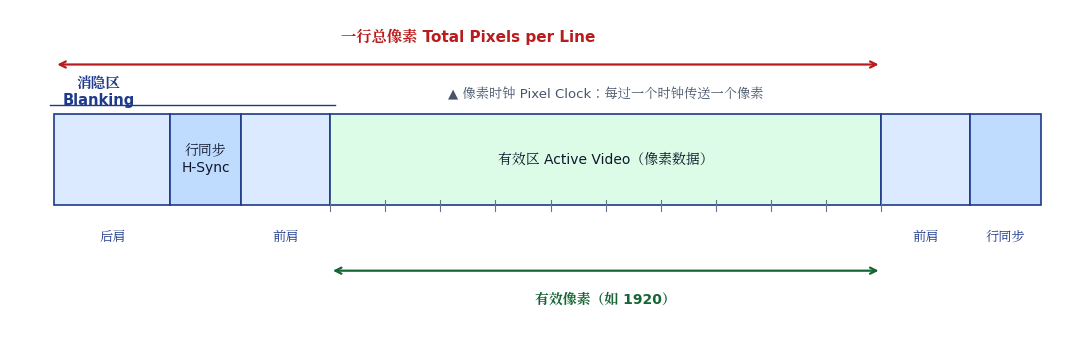
The pixel clock is the "heartbeat" of a video signal: every clock cycle, the interface transfers one pixel of data. The faster the clock, the more pixels transferred per unit time, and the higher the supported resolution and refresh rate. For example, the typical pixel clock of 1080P@60Hz is 148.5MHz — 148.5 million pixels per second.
A video signal is transmitted line by line. A line is not all picture content — it has two parts:
Sync signals have another important attribute —Polarity: H-Sync Polarity and V-Sync Polarity They specify whether the horizontal and vertical sync pulses are "positive" (high during the pulse) or "negative" (low during the pulse). The receiver must detect sync edges at the correct polarity — a reversed setting causes sync failure or picture anomalies — so every standard timing explicitly marks both polarity parameters.
A frame consists of many lines, and likewise not all lines show picture. The lines beyond the active lines (e.g. 1080) belong to the Vertical Blanking (V-Blanking), which contains the V-Sync signal telling the receiver "this frame is over — return to the top for the next". Using the H- and V-sync signals, the display reconstructs a one-dimensional pixel stream into a two-dimensional picture.
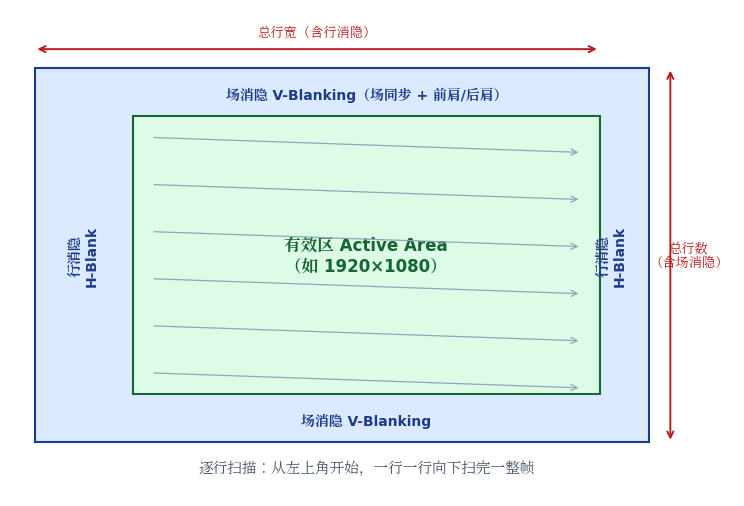
Frame rate, resolution and pixel clock constrain each other as follows:
Take the most common 1080P@60Hz (CEA-861 standard) as an example:
| Parameter | Value | Notes |
|---|---|---|
| Active area | 1920×1080 | Actual picture pixels |
| H front porch / H-sync / H back porch | 88 / 44 / 148 | Horizontal blanking totals 280 pixels |
| Total pixels per line | 2200 | 1920 + 280 |
| V front porch / V-sync / V back porch | 4 / 5 / 36 | Vertical blanking totals 45 lines |
| Total lines | 1125 | 1080 + 45 |
| H-Sync Polarity | Positive (+) | Sync pulse active-high |
| V-Sync Polarity | Positive (+) | Sync pulse active-high |
| Pixel clock | 148.5MHz | 2200×1125×60 = 148.5M |
Panels and whole sets are extremely strict about timing: wrong parameters cause at best picture shift or flicker, at worst a panel that will not light up at all. An LCM signal source must output every timing parameter exactly per the panel datasheet — this is the core capability of Yuanwei Technology’s signal source products: hundreds of built-in standard timings, individually programmable front/back porch and sync width parameters, and 8K ultra-HD timing output, covering pattern testing, aging and functional testing for all kinds of panels and whole sets.